MAGNETIC BRANDS THAT ATTRACT

How to modernise your business without losing its soul: rebranding, SEO and visibility in the AI-era
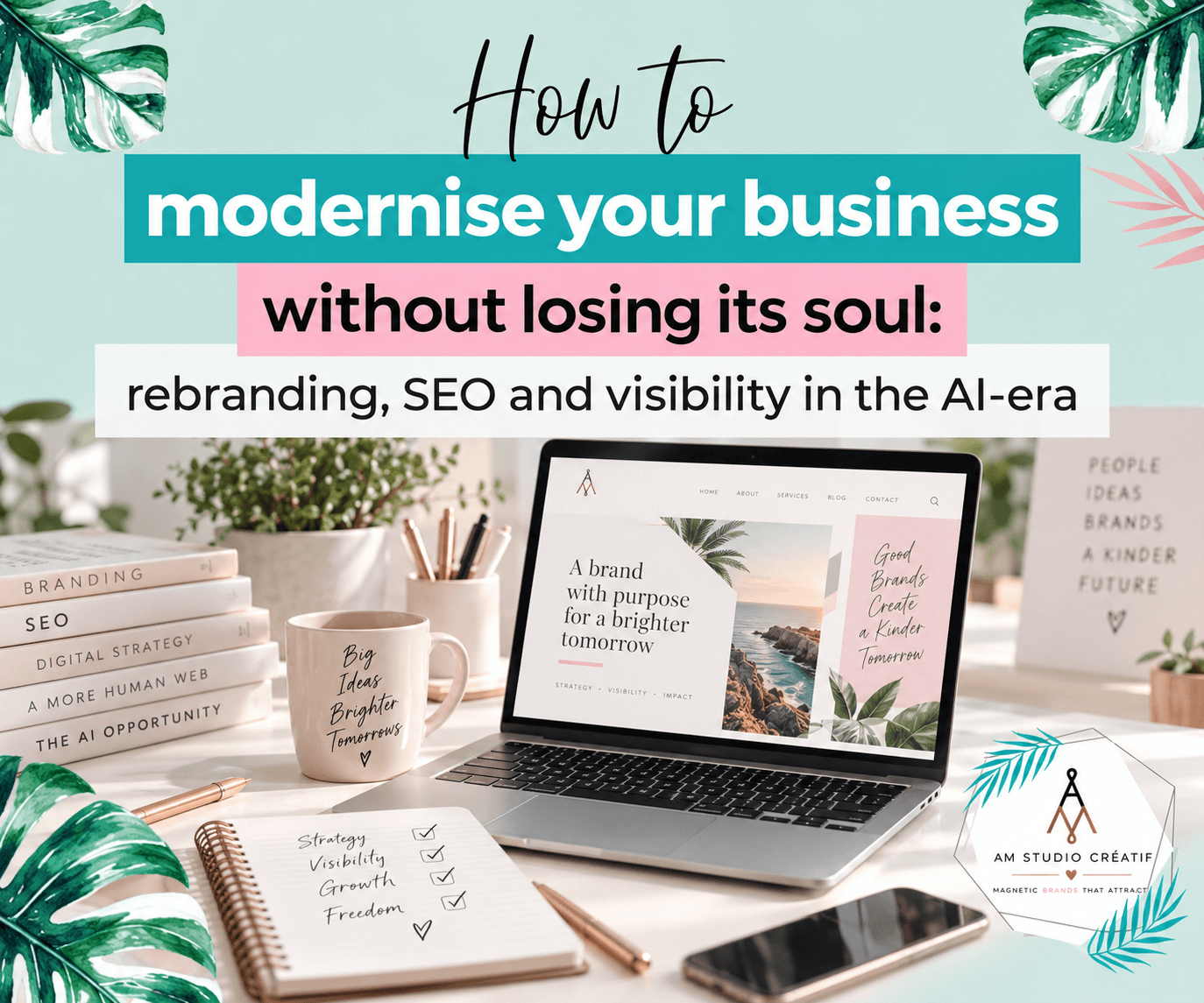
Modernising your business without losing its soul means evolving your brand and digital presence without erasing its history, values or expertise. As Google and AI tools change the way clients search for businesses, modernisation now involves far more than rebranding: it also includes your website, SEO and online visibility.
In this article, you’ll discover how to modernise your brand, strengthen your visibility on Google and prepare your content for AI-powered search — without losing what makes your business genuinely different.
Let’s get into it.
There comes a point when your branding built a few years ago no longer tells the full story of the business you have become today.
Your services have evolved. Your team has grown. Your expertise has deepened. Your clients, ambitions or even the direction of the company may have changed… while your logo, website and communication are still presenting an older version of the story.
And honestly? That is usually a good sign.
It means the business has moved forward. The problem is not your history. It is simply that your brand and digital presence have not caught up with everything that has happened behind the scenes.
Modernising your branding does not mean starting again or erasing what came before. It means protecting what gives your company its value — its knowledge, roots, reputation and personality — while updating the way it presents itself, builds trust and gets discovered today.
Today, it goes far beyond the logo. It includes your website, content, search visibility and the way future clients find your business on Google… or inside an answer generated by AI.
So, how do you bring the whole ecosystem forward without losing the soul of the brand? Let’s look at it properly.
How do you know when your business has outgrown its current branding?
A brand identity does not become outdated simply because it is a few years old. Some identities age beautifully.
The real warning sign appears when the impression created by your brand no longer matches the reality of the business.
You may feel that disconnect when:
your offers have changed, but your communication still focuses on services you no longer want to lead with;
your business has gained experience or moved into a higher-end market, but the visual identity still feels hesitant, homemade or improvised;
a new generation has taken over a family business and wants to modernise it without losing its heritage;
your team, premises or way of working have evolved, but the website still describes the company as it was five or ten years ago;
your social media feels more current than your website — or the other way around;
people who discover you cannot immediately understand what you do, who it is for or why they should choose you.
Here is a very real example for a family business. A family business may have twenty years of expertise, an excellent local reputation and loyal customers. But if its website is dated, difficult to use on a phone or missing important information, someone discovering it for the first time cannot see all that value yet. They only see an online presence that does not reflect the real standard of the company.
That is where rebranding becomes valuable: not to invent a new personality, but to make the existing one visible.
Rebranding does not mean erasing your company’s history
The word rebranding can sound rather dramatic. It sometimes suggests a complete break from the past: a new name, logo, colours, voice and direction, as if everything familiar has to disappear for the business to feel modern.
But a thoughtful rebrand begins with a much more sensitive question:
What must we protect?
What should stay
Depending on the company, this may be:
a symbol clients already recognise;
a colour with genuine history or meaning;
expertise developed and passed down over many years;
a warm, personal approach that has become inseparable from the brand;
a family name, origin story or particular way of welcoming clients.
These elements are not obstacles to modernisation. They are its foundations.
What may need to evolve
We can then work on everything that no longer communicates the business clearly: the legibility of the logo, the visual world, photography, brand language, the way offers are organised, the website experience and the consistency between each touchpoint.
The result should not feel as though a completely different company has taken your place. Existing clients should still recognise you, while new clients finally understand the value that was there all along.
That is how we approach rebranding in Réunion: with respect for the company’s history, a clear understanding of the local market and a vision for where the business is going next.
The short answer: Modernising a brand without losing its soul means preserving its distinctive story, values and character while updating its identity, message and digital presence to reflect the business as it is today.
Modernising your brand image also means modernising how you get found
There is a lot of excitement around AI-generated images, avatars, video and all the spectacular new creative tools — and yes, we love testing them at the Studio too.
But while everyone is looking at the shiny part, a much deeper change is happening quietly in the background.
The way future clients search for, discover and evaluate a business is changing.
People no longer search only for phrases such as “communications agency Réunion” or “website designer Réunion”. They are increasingly asking longer, more specific and more conversational questions:
Which agency can modernise a family business in Réunion without losing its history?
How do I choose someone to redesign my brand and website?
How can a local business improve its online visibility?
Does SEO still matter if people are searching with AI?
Google can now generate a summary for certain searches and guide users towards the sources it considers useful. Other platforms, including ChatGPT and Microsoft Copilot, can also search the web and cite pages while answering a question.
Digital visibility is no longer happening only inside a traditional list of blue links. A company still needs to appear in standard search results, but its content may also become a source used or cited in an AI-powered search experience.
Is SEO still relevant when people use AI answer engines?
Yes. SEO remains the foundation of online visibility, including visibility in generative search.
Google says this very clearly in its 2026 guidance: its generative search features are built on the core ranking and quality systems of Google Search. For a page to be eligible to appear as a supporting source, it must still be accessible, indexable and able to appear in traditional search.
So there is not an “old SEO” that has suddenly become useless, followed by a completely separate magic formula for AI.
The fundamentals still matter:
a clear technical structure;
pages that search engines can access;
a fast, readable, mobile-friendly website;
a logical content architecture;
reliable and current information;
genuinely useful writing created for people;
recognisable first-hand experience and expertise;
internal links that connect related pages and ideas.
For businesses with a physical address, local SEO (geo-localisation) is still especially important. A complete Google Business Profile, consistent contact details, accurate service pages, local case studies and content shaped around the needs of the people you serve — and search systems — need to all understand where you work, what you offer and who you serve.
SEO, AEO and GEO: what is the difference?
Here is the simple version:
SEO — Search Engine Optimisation: improving a website and its content so search engines can access, understand, index and display it.
AEO — Answer Engine Optimisation: making information clear and reliable enough for an answer engine to identify and use when responding directly to a question.
GEO — Generative Engine Optimisation: a term commonly used when discussing brand visibility and citations inside answers produced by generative search tools.
In practice, these areas overlap significantly. Google itself considers optimisation for generative search to be part of optimising the search experience — in other words, still SEO.
The smart move is not to choose SEO or AEO. It is to build a presence that is clear, useful and trustworthy enough to work in both environments.
How can you make your content easier to understand and cite?
There is no guaranteed switch that makes a brand appear in AI answers. But there are sensible ways to make your content more useful to people, traditional search engines and answer engines.
1. Answer the questions your clients actually ask
A service page that simply says your team is “passionate, dynamic and attentive” sounds pleasant, but it is almost impossible to distinguish from hundreds of others.
A useful page explains:
who the service is for;
what problem it solves;
how the process works;
what is included;
where the service is available;
what clients usually want to know before making a decision.
That level of clarity does not remove the brand’s personality. It gives its expertise somewhere to shine.
2. Create content rooted in real experience
Search engines already have access to a huge amount of generic information. What becomes valuable is what your company can add: experience from the field, a particular method, genuine examples, proven results and knowledge of a profession or place.
A communications agency in Réunion could publish another generic article about choosing logo colours. But it would be far more useful to explain how to modernise an established local company, how to preserve heritage without making a brand feel dated, or how to shape a digital presence around the needs of a Réunion-based audience.
Your experience is difficult to copy. That is what gives content substance.
3. Structure pages so they are easy to navigate
Descriptive headings, readable paragraphs, direct answers, concrete examples and a genuinely helpful FAQ make a page easier for people to use.
They also help search systems identify the subject of the page and the answers it contains. But this does not mean chopping every thought into artificial little fragments “for the AI”. Google states that there is no perfect word count or special format required. The priority is still clear, satisfying content for the reader.
4. Connect your content instead of publishing isolated pages
An article about rebranding can lead to a relevant case study. That project can link to a page explaining the website process. The service page can then offer a discovery call or a useful resource.
These internal links are not only there for SEO. They create a natural path for someone who has just discovered your world and wants to understand it better.
5. Make sure search systems can access the website
Beautiful content that search crawlers cannot access remains… invisible.
It is worth checking page indexing, the robots.txt file, sitemap, key metadata and whether important information appears as readable text. For ChatGPT Search specifically, OpenAI explains that websites blocking OAI-SearchBot cannot be included in ChatGPT search answers, although they may still appear as navigational links.
This side of the work is more technical, but it belongs in any serious approach to AI search visibility.
Why your website is still the hub of your digital presence
We regularly hear that social media has replaced the business website, sales funnels also… Yet when people want to properly evaluate a company, compare its services or check its credibility, the website is still where the complete picture comes together.
Social media is brilliant for creating the first connection. It allows you to share what is happening, show the people behind the business, stay visible and bring people into your world.
But social content is fragmented. It depends on an algorithm and becomes difficult to find surprisingly quickly.
Your website organises the story. It presents your offers, gathers your work, hosts your articles, answers questions and guides visitors towards the next step.
It becomes the central hub for your growth — the source of truth that all your other channels can connect back to.
A connected digital ecosystem works like this
Your brand identity creates recognition. It gives every touchpoint a coherent and memorable personality.
Your content demonstrates expertise. Articles, case studies, answers and resources make your knowledge visible.
Your social media creates connection and familiarity. It helps the right people discover you and leads them back to your website.
SEO and AI-powered search support discovery. They help your pages appear when someone is looking for an answer or a trusted provider.
Your website reassures and guides. It gathers the information people need to understand, compare and decide.
Your funnels and conversion paths offer the next step. Booking, requesting a quote, joining a list or buying becomes clear and natural.
When these elements begin speaking to each other, your online presence no longer depends on one isolated post or a lucky moment with the algorithm.
It starts working as a system.
Two Capetonian businesses, two very different modernisation needs
Imagine two established companies in Cape Town, South Africa.
The first is a family business now being led by the next generation. Its reputation is excellent, but the identity feels dated and the website does not show the newer services. The work needs to begin with the positioning: deciding what should be protected, then updating the visual identity, language and website around that foundation.
The second already has a strong, well-liked identity but depends almost entirely on Instagram. It publishes regularly without having useful pages that answer the questions future clients are searching for. This company may not need a new logo at all. The priority could be website creation, local SEO, expert content and a pathway that turns visibility into genuine enquiries.
In both cases, purchasing “a new logo”, “a few posts” or “some SEO” as unrelated tasks would address only part of the problem.
The right solution depends on the real gap between the company, the way it currently presents itself and the way people discover it.
The AM Studio Créatif approach: modernising the whole ecosystem
At AM Studio Créatif, we do not see branding, websites, content and customer acquisition as four separate subjects.
A beautiful identity cannot compensate for a confusing website. An elegant website does very little if nobody can find it. And visibility loses its value when people arrive in a world that does not reflect the standard or personality of the company behind it.
We look at the complete picture:
what the brand is saying;
what its visual identity makes people feel;
what the website helps them understand;
how the content builds confidence;
where future clients discover the business;
what next step is offered once you have their attention.
This is also the thinking behind the Visibility Pack: ongoing support that allows us to improve the brand identity, website, content and visibility according to the company’s real priorities. Not to add more tools for the sake of it, but to build a connected ecosystem that fits the business.
Because a modern brand is not simply one that follows trends. It is a brand whose story, image and digital presence are finally telling the same story.
Where should you begin?
Before discussing logos, AI or keywords, begin with a clear review of where the business stands today.
Ask yourself these five questions:
Does our image reflect the current standard of the business?
Can someone who does not know us quickly understand what we do and why we are different?
Is our information consistent across our website, Google and social media?
Do we publish content that genuinely answers the questions our future clients ask?
Once someone discovers us, is their next step clear?
Your answers will usually reveal the priority: rebranding, a website redesign, SEO, content strategy, a better customer journey… or a gradual combination of several elements.
You do not need to change everything overnight. The important thing is to put the pieces back in the right order, beginning with whatever is currently limiting understanding, trust or visibility.
Frequently asked questions about rebranding, SEO and AEO
What is the difference between redesigning a logo and rebranding?
A logo redesign focuses mainly on the visual mark. Rebranding goes further and may include positioning, messaging, visual identity, tone of voice, website and the overall brand experience. Its purpose is to align the way people perceive the company with what it has become.
Should businesses stop investing in SEO and focus on AEO instead?
No. SEO provides the technical and editorial foundation that allows search engines to find, understand and index a website. AEO builds on that work by making the company’s answers clear and useful in conversational and generative search experiences.
How can a business appear in AI-generated answers?
No method can guarantee a citation. A company can improve its chances by publishing public, accessible, reliable and well-organised content based on genuine expertise. It should also ensure relevant search crawlers can access the website and keep its information current.
Is local SEO still important in Cape Town?
Yes. Accurate local signals help both clients and search systems understand where the company is based and the areas it serves. The website, Google Business Profile, contact information, service pages, reviews and Cape Town-based case studies should all communicate consistent information.
Do we need to rebuild the entire website to improve digital visibility?
Not necessarily. An audit may show that improving the structure, written content, service pages, internal links or technical foundations is enough. A complete redesign becomes valuable when the website no longer matches the company’s brand, services or commercial goals.
Modernise, yes — but remain unmistakably you
Artificial intelligence is already changing the way we create, search and choose. But it does not take away the qualities that make a company valuable: experience, reputation, conviction, perspective and the quality of what it delivers.
The goal is not to make your business look “more technological”.
It is to make your story clearer, your expertise more visible and your digital presence easier to discover — on Google, through social media and inside new AI-search experiences.
That is what it means to modernise without losing your soul: evolving the form so the real substance of the business can finally shine.
Would you like to take a fresh look at what your brand and online presence are communicating today? AM Studio Créatif empowers business leaders and companies to build their brand and dominate their market online. Combining recurring monthly marketing, strategic SEO, and a custom Automated Customer Acquisition System, we turn your business into an inbound client magnet—so ideal buyers come directly to you without outbound chasing. Tell us about your project today.
Posts récents

AM STUDIO CRÉATIF
MAGNETIC BRANDS THAT ATTRACT

AM Studio Créatif is a brand strategy and digital marketing studio based in Reunion Island, helping modern entrepreneurs and established businesses build magnetic online brands through strategy, branding, websites, sales funnels, automation and AI-assisted marketing systems.


© 2021-2026 AM Studio Créatif. All rights reserved.